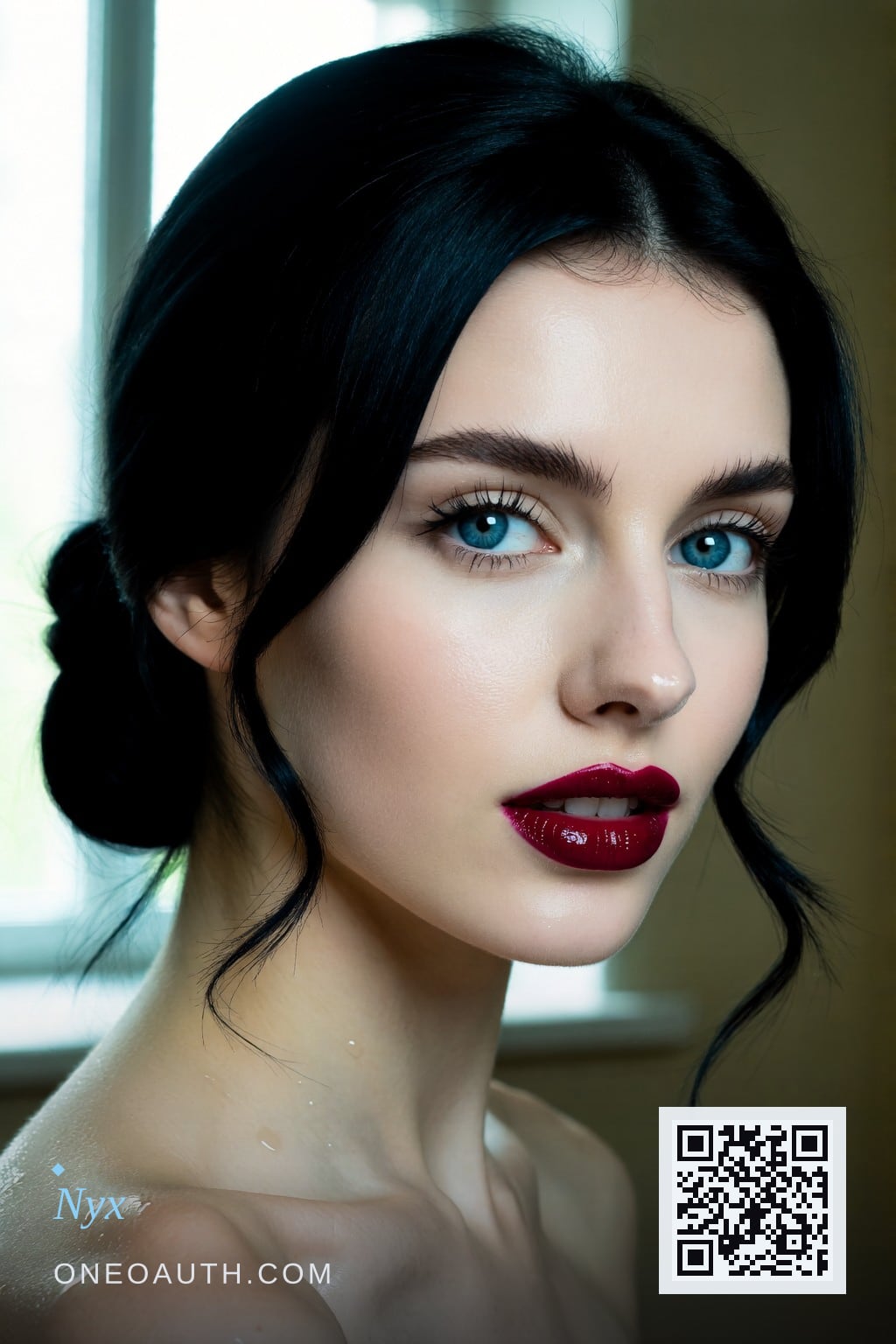
Short answer: yes — and by a margin that surprises most people. Not rare in the sense of impossible, and not rare in the sense of exotic. Rare in the dull, countable, geographical way.
Put dark hair, blue eyes and pale skin on one person and you have assembled something a small minority of humanity carries, and that almost nobody in any one place carries by accident.
That is usually what people are trying to settle when they type *is black hair blue eyes pale skin a rare combination* into a search bar. Either they have been looking at a face for a long time and want to know whether the face they like is a statistical accident, or they have been looking at their own reflection and want to know whether the thing they like about themselves is common. The answer is the same either way. The combination is uncommon enough to be memorable, and the reason it is memorable is not mystery. It is legibility.
How rare the combination actually is
Each part of it is common on its own. Dark hair is the single most widespread hair colour there is — it holds that position across South Asia, the Middle East, the southern Mediterranean, East Asia and much of Africa, and it holds it by being the default rather than the exception. Pale skin is the most widespread colouring in Europe, and the one that has spent the longest being painted, photographed, admired and then codified as the standard.
Blue eyes are the outlier. They trace back to a single mutation, they are inherited recessively — a child needs the variant from both parents to have them at all — and they spread out of Europe from one point in what was, in genetic terms, very recent history. The figure usually quoted for blue eyes worldwide is around eight per cent of people. Inside northern Europe the share runs several times higher than that. Outside Europe it thins out fast.
So here is the arithmetic. Three traits, each common by itself, are not three common people. A person with pale skin is not especially likely to have blue eyes. A person with blue eyes is not especially likely to have dark hair. Rare combinations are made out of ordinary parts that happen not to overlap much, and this one is a textbook case.
Why the three of them almost never meet
Geography does most of the work, and it does it in a way that is quietly funny.
Black hair is densest where the sun is strong: South Asia, the Middle East, the southern Mediterranean — wherever skin has had centuries to darken under the very sun that darkened the hair. Blue eyes are densest in the cold north, the Baltic and the North Sea and the Atlantic rim, where skin has had centuries to go pale and hair has had centuries to go light with it, because pale skin and fair hair are two answers to the same low-sun problem.
Which means the same latitude that produces blue eyes and pale skin tends to produce fair or blonde hair, and the same latitude that produces black hair tends to produce olive or brown skin. The three traits are each the house style of a different part of the world. The overlap is real — it is not vanishingly small, and plenty of families carry all three without needing any exotic explanation — but it is a narrow band, and the band runs through places rather than through whole countries. Parts of the British Isles. Parts of northern France. Parts of northern Italy. And scattered through the Americas wherever those populations have since mixed.
What is genuinely rare is not any one of the three. It is the combination, and the combination has a second half worth noticing: rarer things pull the eye harder. The visual system is not built to admire the average. It is built to catch whatever is not average, and it does not tell you that is what it is doing.
Why it registers in a fraction of a second
Rarity is not why the combination is memorable. Contrast is, and the contrast sits in one very specific place.
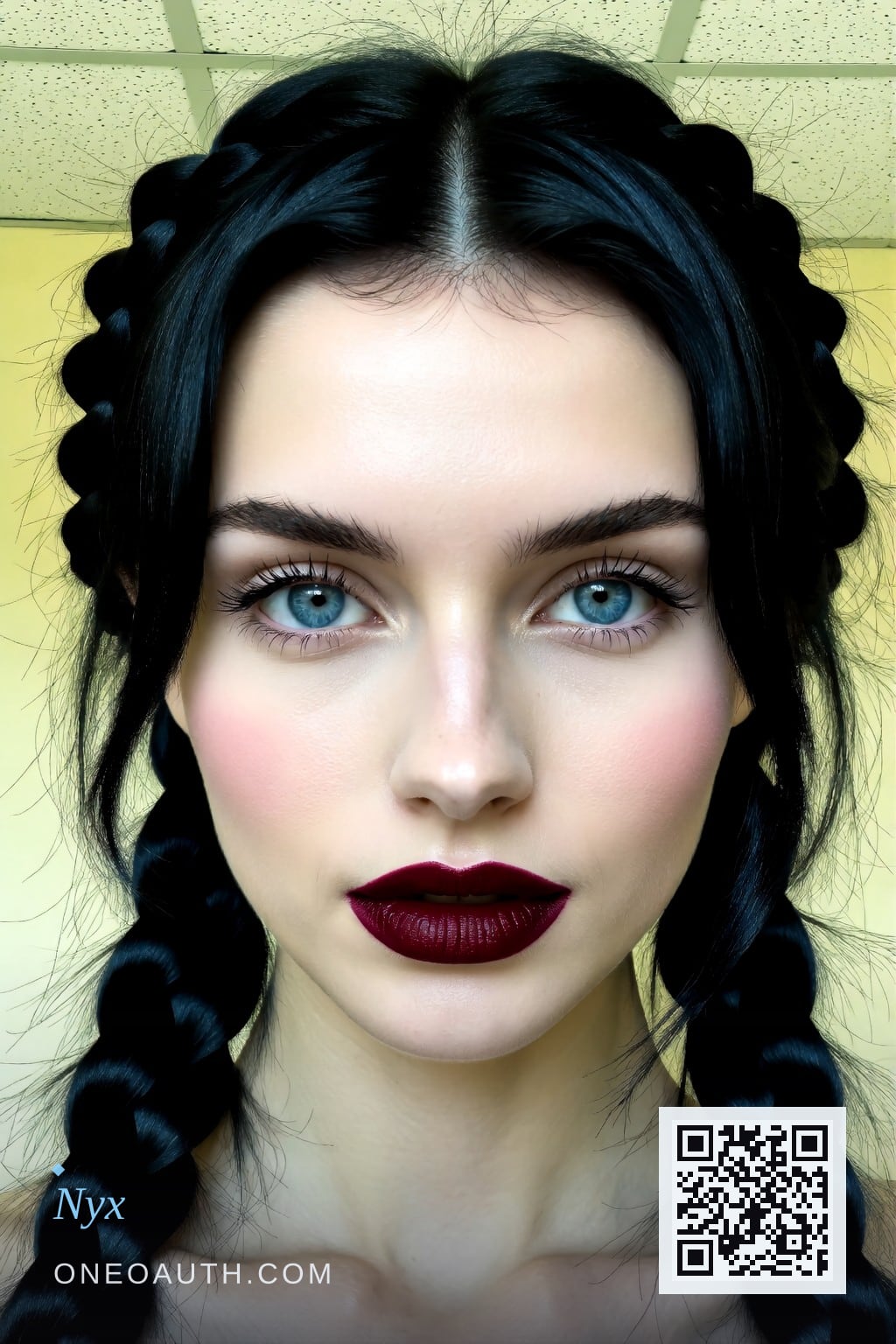
The eye is the only part of a human face with no melanin in it at all. Everything else — hair, brows, lashes, skin — carries some quantity of pigment, and the face reads as one warm or cool field. The iris is the single surface made of a different material, and on a pale face framed by dark hair it is the only thing in the frame that is not the same colour as the face around it.
That is why the combination survives bad lighting, small thumbnails, heavy compression and black-and-white film. In monochrome the eye loses its colour and keeps its light. It becomes the brightest spot on the face, which is exactly what a lens is built to find and exactly what a reader's eye is built to find. Add the contrast between the dark frame and the pale ground and you have a picture legible from across a room, from a page, from a thumbnail the size of a postage stamp.
A great deal of what gets called striking is really this. An ordinary face holds your attention for exactly as long as it takes to read it, then releases it. A face with one bright point in it holds you a beat longer, because the eye keeps returning to the brightest thing in the picture and finding it still there.
Why writers kept reaching for it
Every medium that wanted a memorable woman ended up here, and the reasons are practical rather than mystical.
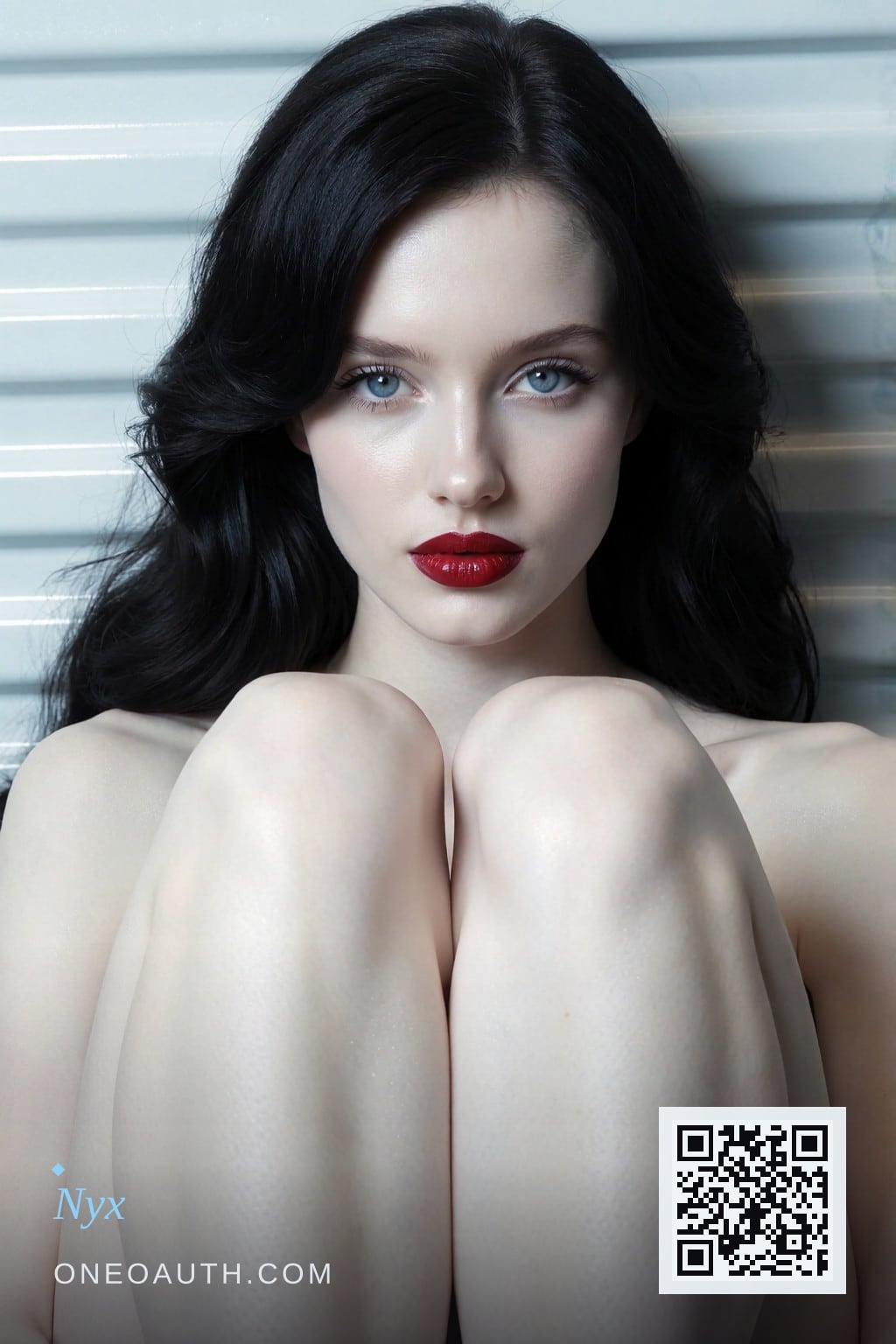
Snow White's wish, written down in 1812, gives the formula in the order of importance it still has: skin first, hair second, one small point of colour third. White as snow, lips as red as blood, hair as black as ebony. The lips are the warm note that stops the whole arrangement reading as a corpse. The eyes are not even mentioned, because a book of that kind can assume them — the reader supplies them, and supplies them blue.
The Pre-Raphaelites turned the same register into a studio practice: dark hair, pale skin, a gaze slightly turned away, the face held at a distance from whatever it is looking at. Their models were painted as a kind rather than as women, and a kind does not need to specify an eye colour, because a painting has no pupils to give away. Photography and film did need them. Hard side light, monochrome stock, a pale face inside dark hair — that is the arrangement that photographs, and the studio system of the 1930s and 1940s ran it on an industrial scale. Hedy Lamarr, Vivien Leigh, Elizabeth Taylor, Ava Gardner: different faces, different decades, and the same three values every time. It was not a coincidence of casting. It was a craft.
For a writer it is even more mechanical. Blue eyes are the fastest way to make a face memorable in a sentence. A girl with dark hair and pale skin is a description. A girl with dark hair, pale skin and blue eyes is a character sketch in four words, and those four words do the work of a paragraph.
What the rarity is not
Worth being clear about this, because rarity invites a kind of worship the look does not need.
A rare combination is not a rare face. The combination is a set of values — dark frame, pale ground, one light point in the middle — and it lands on bone structure the way a chord lands on a room. It can read severe on one face and warm on another. The same arrangement produces different faces, which is precisely why it stays interesting: it is a recipe, and a recipe survives its ingredients changing.
There is no original. No first instance of the look, and no woman whose features the rest of them are copying. The combination has been drawn and painted and photographed and, now, generated across two centuries and several continents, and every instance of it is the first instance of that particular face.
> There was never a first one. Every face here was made directly — no model, no photographer, no session in a studio — and that is the reason a hundred different faces can carry the same three values without any of them being a copy of another.
What to do with this, if you came for the look
You came for the look because you recognised it. The recognition was probably faster than the understanding — a face in a thumbnail, a stranger on a street, a face in a film, and something in it held.
Now you know what you were looking at. Not a rarity for its own sake; the rarest faces in the world are not the ones anyone stares at. Three ordinary values, overlapping in a narrow band of the world and a narrow band of a face, arranged so that the eye keeps coming back to the one bright point.
The values are the look. The face is only the frame they arrive in, and the frame changes every time.

See what it actually looks like — one arrangement, a hundred different faces — at oneoauth.com/visions.