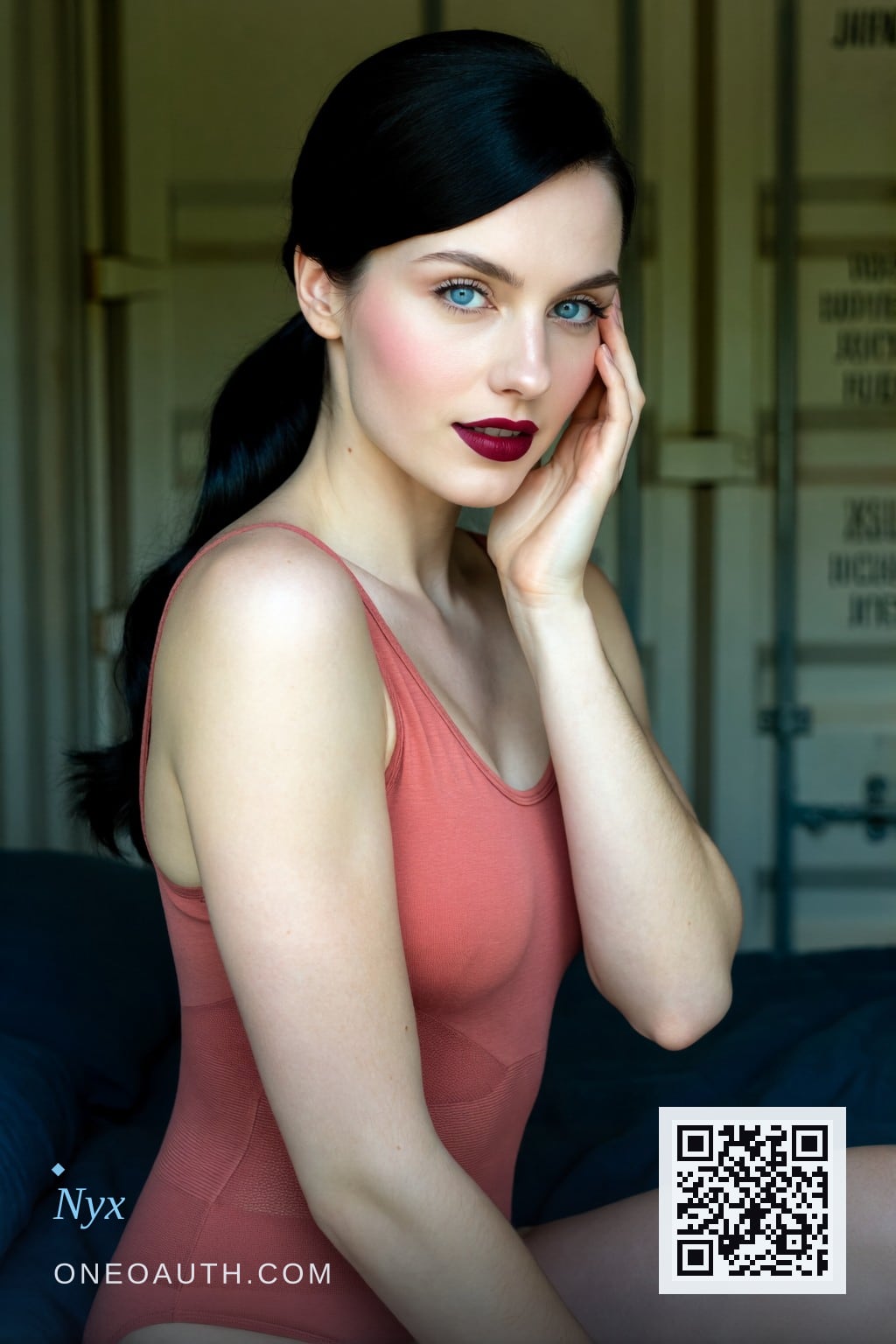
A code that everybody reads at first glance, and almost everybody reads wrong
Type *blue eyes black hair character archetype meaning* into a search bar and the page that comes back, almost every time, will tell you the combination signals something dark. Mysterious. Cold. A little dangerous. Somewhere between *brooding antihero* and *read the fine print before dating her*. The same adjectives show up on list after list, on TikTok after TikTok, on Pinterest board after Pinterest board. The agreement is so consistent that it has started to feel like the answer.
It is the wrong answer. It is wrong in a particular way, and the way it is wrong is the more interesting story.
The pale, dark-haired, blue-eyed face is the most reproduced face in Western visual culture. It has been re-rendered, with very small changes, for every medium that has tried it for two hundred years. Oil, newsprint, monochrome film, anime, photostock, generative models. The reason it keeps getting re-rendered is the reason every listicle that tries to explain it gets it wrong: the people writing the listicles have looked at the *colour* and stopped there.
The code is not a colour. It is a posture.
What the colour actually says
Start with what is on the surface, because it is real. The combination does signal something cold. Pale skin against dark hair against light irises is, mechanically, a high-contrast recipe that reads as composed and distant. The brightness of the eyes against the darkness of the frame keeps the face slightly out of reach. The skin has no flush in it, so the face reads as thinking rather than feeling, even when it is feeling a great deal. None of this is invented. It is what the combination does on the page.
What the colour does not say is *who* the woman is. That is the part the listicles get wrong, because the listicles were written by people who could describe the picture and not what was happening inside it.
The combination comes out of a contrast recipe first written down in 1812, in the Brothers Grimm. Pale as snow. Lips as red as blood. Hair as black as ebony. Three values placed against each other — the lightest possible ground, the darkest possible frame, one small warm note to keep the face from reading as a corpse. The Brothers did not specify eye colour. They specified a contrast ratio. Blue eyes are what that contrast ratio produces naturally: light enough to read against the hair, pale enough to merge with the skin. The eye colour is not a separate aesthetic layered on top. It is part of the contrast working as designed.
So far, the listicles have it right. Cold surface. Contrast recipe. A face that holds attention half a second past the point where a resolved face would have released it. None of that is wrong. None of it is goth, either.
Why the misreading happens
Goth is a subculture. It has a wardrobe, a music history, a deliberate signal of separation from ordinary life. Black makeup, black clothes, the whole thing worn as a statement of belonging somewhere else. To read the archetype as goth, you have to import those signals. The eyeliner. The lace. The candlelit room. The intent.
Strip those signals and what remains is a woman who could have been standing in a Pre-Raphaelite studio in 1860 or in a film still in 1955 or on a feed in 2026. Strip the eyeliner, and the face does not stop being the archetype. The archetype survives intact without any of goth's signal-noise, because the archetype is doing different work.
That is the first way the misreading happens. The listicle writers see the cold surface and assume the cold surface is the point. It is not the point. The cold surface is the *frame*. What the archetype is for, what it has been for since 1812, is to show that something is happening underneath a face that does not give you access.
What the women holding the archetype were actually doing
This is the part the listicles cannot reach, because the listicles are written about pictures and not about the women inside them.
Elizabeth Siddal was a Pre-Raphaelite model and later, against most of the expectations of her time, a painter in her own right. Jane Burden sat for hours in heavy gowns while Dante Gabriel Rossetti worked, and the expression in those sittings reads as patience rather than invitation. The Pre-Raphaelite muses were not decorations inside the picture. They were collaborators in the slow construction of a serious image. They were the painters' working definition of what a serious woman looked like when she was not performing for the camera.
The coldness of the look — the pale skin, the distant eyes, the dark hair — was the surface. The warmth was the work the woman was doing while you looked at her. That is what every modern version of the archetype is trying to carry. The cold reads at a glance. The warmth only reads if you stay with the face long enough to notice the woman inside it is occupied.
The internet, which scrolls, does not stay with the face. The internet is built for the cold reading. That is why the listicles keep winning. The cold reading is the reading you can fit in a thumbnail. The cold reading is the reading that travels on Pinterest. The cold reading does not require knowing anything about the women who held the face before the camera caught up with them.
Why the misreading is now baked into the archetype
There is a feedback loop, and it is worth naming.
The look gets re-rendered for each new medium. The new medium uses the cold surface, because the cold surface is the part that photographs well. The cold surface gets circulated as the whole of the archetype. The next listicle, written by someone who has only seen the circulated version, describes the cold surface as the meaning. The next medium, working from the listicle, doubles down on the cold surface. The archetype loses another layer of warmth each cycle.
Generative models trained on the circulated images inherit the cold surface as the entire personality. The models produce beautiful, cold, dead-eyed faces. The faces get circulated. The listicles update. The feedback loop continues.
This is the part that is not a stylistic preference. It is a real loss. The archetype was once a way of saying *the woman in this picture is doing something you are not seeing*. The archetype has become, through the listicles and the thumbnails, a way of saying *the woman in this picture is not doing anything at all*. The cold surface is now the whole of what is shown.
Why it survives anyway
The archetype survives the misreading because the cold surface, taken on its own, is still good to look at. The composition is sound. The contrast ratio works in any medium. A still, pale, dark-haired, blue-eyed face against a quiet background is always going to hold attention, even when the woman inside it has been flattened into a mood.
That is also why the misreading persists. The misreading is not punished by the medium. The archetype performs well even when the woman inside it has been removed. So the listicle version keeps getting made. So the cold surface keeps getting circulated as the whole of what is there.
The interesting question is what it looks like when the warmth is allowed back in.
What the warmer reading looks like
The warmer reading is not sentimental. It is not a softer face, or a warmer palette, or a smile added to the picture. The warmer reading is the same cold surface with the woman restored to it.
It is the painter who is also the model. It is the muse whose expression in a six-hour sitting reads as attention rather than availability. It is the face whose gaze is aimed at something the viewer cannot see, and the something turns out, on closer reading, to be the work the woman is doing. Cold on the outside, occupied on the inside. The face holds attention because it has not resolved, and the reason it has not resolved is that the woman inside it is not finished with what she is doing.
That is the meaning of the archetype. The listicles cannot tell you this, because the listicles are written about pictures and not about the women inside them. The medium cannot show you this, because the medium shows the cold surface and stops there. The archetype carries it anyway, in the same way it has carried it since 1812, because the women holding it have always known what they were doing while the rest of us were looking at the colour.
The misreading is going to continue. The cold surface is too useful for the misreading to stop. What is worth knowing is that the warmer reading is the older reading, the colder reading is the invention, and the woman in the picture has been doing something other than what the listicle says since before the listicle existed.
What to look for next time the face stops you
Next time the pale, dark-haired, blue-eyed face stops you — on a feed, in a film, in a painting, in a generative still — try staying with it for the half second past where the cold surface has resolved. Notice whether the gaze has somewhere to go. Notice whether the posture is decorative or occupied. Notice whether the woman inside the frame is performing for the camera or is, instead, doing something the camera has caught without her cooperation.
If the gaze has nowhere to go, what you are looking at is the listicle version. The cold surface, the mood, the dark-and-mysterious reading. It is a fine picture. It is not the archetype.
If the gaze has somewhere to go, what you are looking at is the older version. The cold surface is still there — it is the frame, not the point — and the warmth is what the woman is doing while you look at her.
That is the blue eyes black hair character archetype meaning, as it has been since 1812. Not goth. Not a listicle. Not a mood. A code that carries, at the same time, the cold surface and the work being done underneath it.
The code, rendered close: the colder reading is the one that photographs. The warmer reading is the older one.
The misreading is the cost of the surface. The archetype is what survives underneath.
The face holds attention because it has not resolved. The older reading says: it has not resolved because the woman is doing something you cannot see.
See what the look actually shows at oneoauth.com/visions.